You see it from the back deck. A white streak across two panels, right below the spot where the birds line up on the ridge. A yellow film that showed up in April and never rinsed off.
Rain does a lot of the work on solar panels. It doesn’t always finish it. Droppings bake on. Dust and pollen can dry into a film after a light shower.
We clean solar panels for homes and businesses around Evansville, on roofs and on ground racks. We work from the ground, a ladder or open roof beside the array. Never from on top of the panels. Not sure yours need it? Start with a free exterior evaluation.
What builds up on solar panels
NREL, a national lab of the U.S. Department of Energy, published a best practices guide for solar operation and maintenance in 2018. Its cleaning pages name the usual sources of dirt. Here’s what lands on panels, and what the guide says about each one.
- Bird droppings. The guide says uneven soiling “can lead to localized hot-spot failures.” It goes on: “Efforts should be taken to reduce uneven soiling, for example, from bird droppings.”
- Pollen. Its advice is to schedule cleaning “after the end of pollen season.”
- Farm and construction dust. The guide says cleaning can be scheduled after plowing, or after nearby construction is done.
- Film from light rain. Heavy rain cleans panels well. The guide says light rain cleans much less, and “can even increase soiling” when dust sticks to scattered drops.
- Leaves and seeds. They gather along the low edge of each panel. The guide also points out that seeds left by birds can sprout on arrays.
How we clean your panels
The guide’s first cleaning rule is short: “Follow the PV module manufacturer’s recommendations with any array cleaning.” So that’s where we start. We find out who made your panels and read the cleaning section of the manual before we pick a tool.
A water-fed pole at low pressure
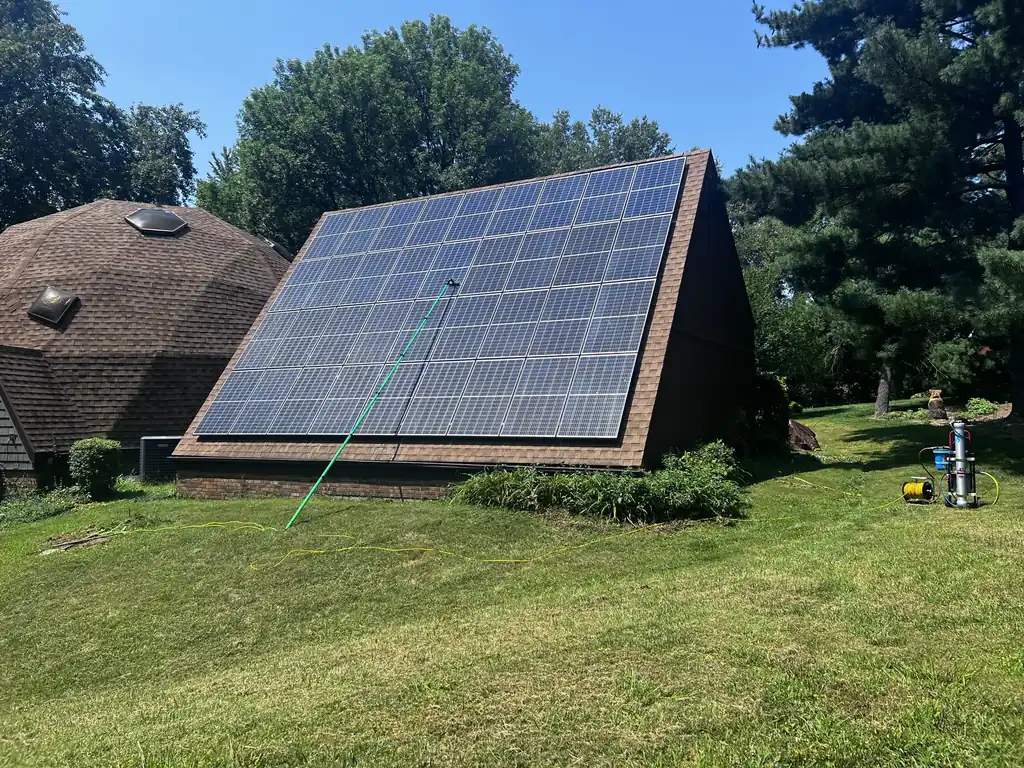
Our main tool is a water-fed pole. It’s a long pole that carries filtered water up to a soft brush head. The water comes out at low pressure, so it rinses instead of blasting. Filtering takes the minerals out of the water, which fits the guide’s call for “plain demineralized water.”
The same guide says not to use “high-pressure water, brushes, or any types of solvents, abrasives, or harsh detergents.” Your panel’s manual may say something different about brushes. That’s why the manual decides. If it allows a soft brush, we use one. If it rules brushes out, nothing with bristles touches your panels, and we’ll tell you up front what that leaves us to work with.
Soap only if the maker names it
Most panels get water and nothing else. The guide allows a mild detergent “recommended by the manufacturer.” If your panel maker names one, we’ll use it. If not, we don’t add any.
We stay off the panels and away from the wiring
We never stand, walk, kneel or lean on a solar panel. Not even for a second to reach the far row. If part of an array can only be reached by stepping on panels, we leave that part and tell you why.
We clean the glass. That’s the whole job. We don’t touch:
- Wiring, connectors or conduit
- The inverter or any other electrical box
- Racking, rails, clamps or ground-mount frames
- Bird guards, screens or netting around the array
If we spot a cracked panel, a loose wire or a nest tucked under the array, we take a photo, stop there and point you to your solar installer.
Rooftop and ground-mounted arrays
On the roof
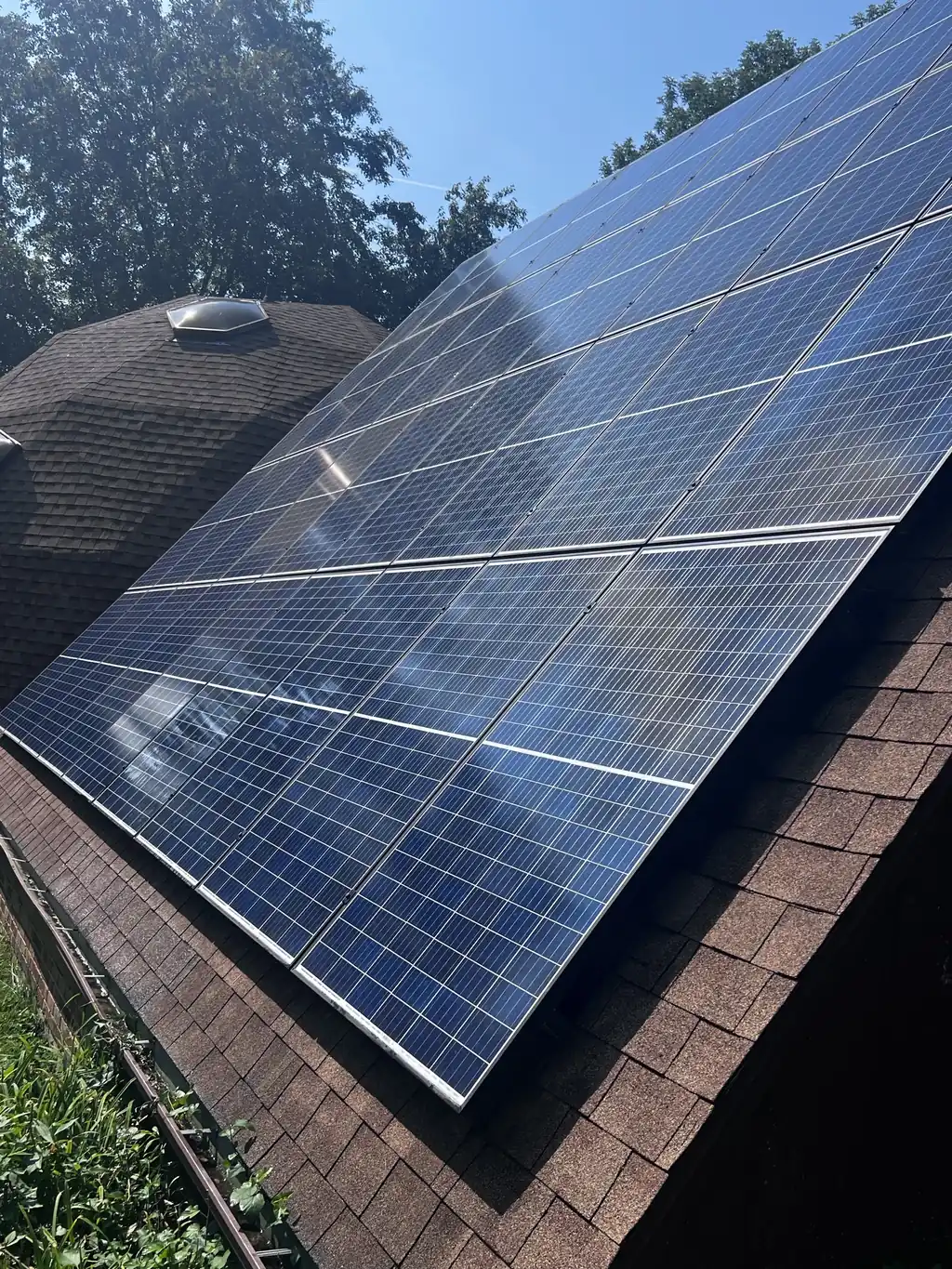
On a house, we usually reach the panels with the pole from a ladder at the roof edge, or from open roof next to the array. We plan where the ladder goes and where we’ll step before anyone climbs. A steep or tall roof can put some panels out of reach without walking on them. We’ll say so at the evaluation, not on the day.
Black streaks on the shingles around the panels are algae, not panel dirt. Getting those off is roof cleaning, a separate soft wash job with its own plan.
On the ground
Ground racks are easier to reach. We can walk the whole array and work every row from the ground. They also tend to get dirtier. The NREL guide says cleaning needs go up for ground-mounted arrays “because they are closer to the source of airborne dirt and pollen.”
Homes and businesses
We clean arrays at houses, shops and other businesses. Managing more than one building? Our commercial and multifamily page covers the rest of the outside work we do for property managers and HOAs.
When a cleaning is worth it
Here’s the honest part. The NREL guide says most owners rely on rain to keep their arrays clean, with no cleaning schedule at all. It cites a study that found routine cleaning wasn’t cost-effective for home, commercial or utility systems.
It also lists the cases where cleaning is needed, and they match what we see: birds, pollen, farm dust and construction dust. So book a cleaning when you can see a problem from the yard. Time it after pollen season, after the field next door is plowed, or after the building project down the road wraps up.
You probably don’t need this if…
- Your panels have light, even dust and you get regular rain. The guide says a heavy rain can clean an array “for free.”
- Your solar company’s service plan already includes cleaning. Use that first.
- Snow is the problem. We don’t clear snow off panels.
- Your system shows an error, or one panel stopped working. That’s an electrical question for your installer, not a cleaning one.
- The only way to reach the panels is to stand on them.
What happens next
Book a free exterior evaluation. We’ll look at the array from the ground, work out how to reach every row without stepping on a panel, and ask what make your panels are. If you have the installer’s paperwork or the panel manual, set it out for us. It tells us what the maker allows.
Skylights on the same roof? Those are on our skylight and rooftop glass cleaning page, and both can get done in one trip. Or call or text Revive Exteriors at (812) 664-6222, Monday to Saturday, 9am to 5pm.
Common questions
Do you walk on solar panels?
No. Panels aren’t a floor, and we don’t treat them like one. We work from the ground, a ladder or the roof beside the array, and the long pole does the reaching. If a row sits too far in to reach that way, we skip it and tell you. Your solar installer may have a way to get to it that we don’t.
Will clean panels make more power?
We don’t promise that, and we won’t quote you a number. NREL’s maintenance guide says the benefits of cleaning can be hard to pin down, partly because the next heavy rain might have done the job anyway. If your system has an app that tracks output, you can check before and after yourself. We’d rather you judge it with your own numbers than take our word for it.
Can you clear snow off my panels?
No. NREL’s guide says snow removal is generally not recommended because it may damage the panels. It also says snow generally slides off steep arrays but not off low-sloped ones. Evansville averages 10.8 inches of snow a year (NOAA 1991 to 2020 normals). If heavy snow on your roof worries you, call your solar installer.