There’s a replacement quote on the kitchen counter. The roof doesn’t leak. It just looks tired, and someone told you it’s time.
Maybe it is. But age alone doesn’t settle it, and the age of the house settles even less. Half of Evansville’s homes were built before 1961, and 22% before 1940, per the Census Bureau’s 2024 American Community Survey. The year on the deed tells you very little about the shingles. An old house can have a young roof. A newer house can have a tired one.
So we judge the roof itself, with 7 questions. They’re the questions we work through during the free exterior evaluation. After the list, we show what we look at on each slope and what pushes the answer one way or the other.
7 questions that tell you if your roof can be restored
Answer these for every slope, not just the one facing the street. If someone else looks at your roof, ask them the same seven, and ask for photos.
- Does it leak anywhere? A leak means water is already getting in. That needs a roofer before anything else.
- Is the deck firm? Soft or sagging spots under the shingles rule out a treatment.
- Is the granule loss even, or in patches? Even wear is usually normal weathering. Bald patches where the black mat shows are a different story.
- Do the shingles lie flat? Curling on a few shingles is one thing. Curling or cupping across whole slopes points to replacement.
- Is the problem everywhere, or in one spot? One damaged spot on a sound slope is usually a repair. Light, even wear on a sound roof is what restoring is for.
- Is it worn, or just stained? Dark streaks are usually algae. A roof can look old and only need a cleaning.
- What do your shingle maker and HOA say? Your shingle maker has its own guidance on treatments, and your HOA may have rules. If either says no, so do we.
No leaks, a firm deck, even wear, flat shingles and no rule against a treatment? Then restoring may be on the table. A good answer from anyone comes with a reason you can see in a photo. If it doesn’t, ask again.
What we look at, slope by slope
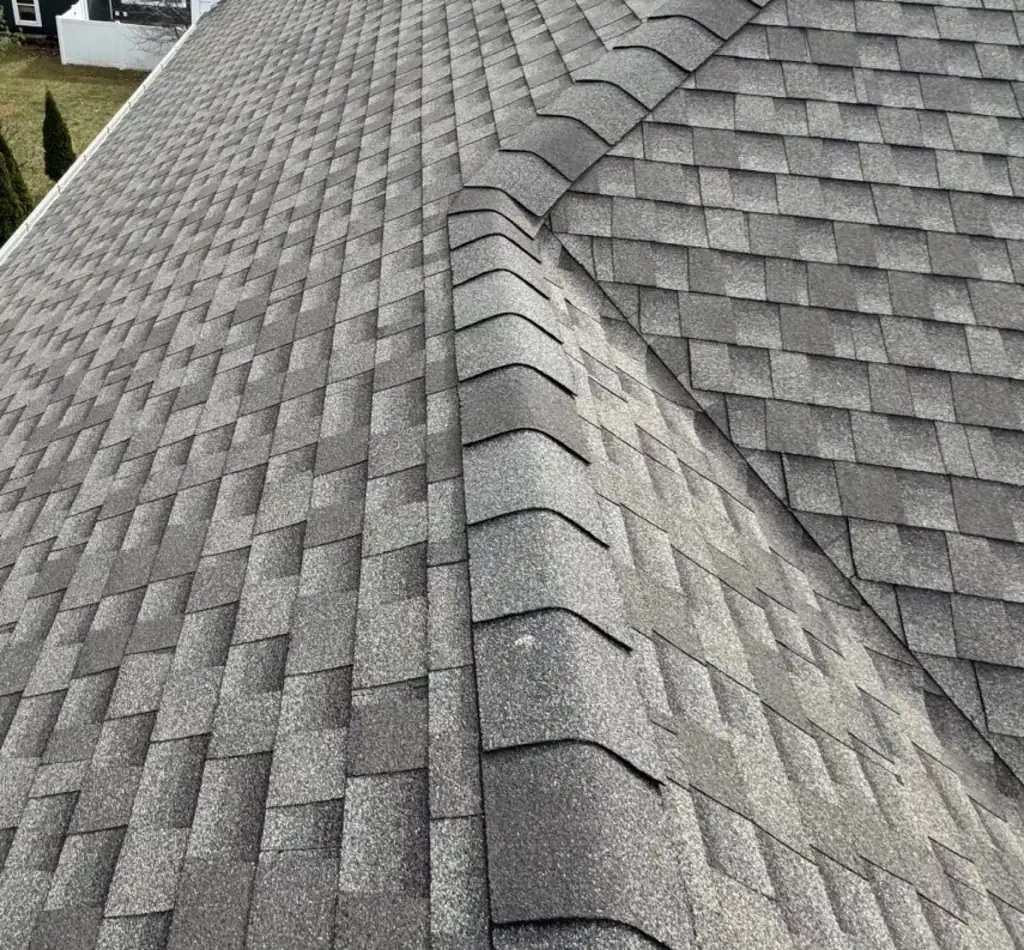
A roof doesn’t wear evenly. Slopes that bake in the afternoon sun age differently from shaded ones that stay damp. So we take each slope on its own and note what it shows.
- Granules. Is the color even, or are there bare patches? InterNACHI says granule loss “which is uniform across the roof is usually a result of normal weathering” (InterNACHI). Patchy loss tells a different story.
- Shape. Do the shingles lie flat and sealed, or are edges curling and tabs lifting?
- Cracks. Are tabs split, or is the surface just faded?
- Flashing. Is the metal at chimneys, vents and walls tight, or pulling away?
- Staining. Black streaks are usually algae. That’s a cleaning question, not a replacement one.
- Damage. Missing shingles, holes, dents, or spots that sag.
You get photos of what we saw on each slope. Then you get a plain answer.
Signs that point to restore
Restoring fits a roof that’s structurally sound but showing its age. The shingles are drying out or losing flexibility, and nothing is broken yet. That’s the roof roof rejuvenation is meant for. We also answer whether an aging roof can be restored instead of replaced in a short FAQ.
- No leaks, and no water stains on ceilings or in the attic.
- Shingles lie flat and stay sealed down.
- Wear is even across each slope, with no bare mat showing.
- The deck is firm, with no sagging between rafters.
- Your main complaints are fading, dullness or streaks.
Even then, a treatment isn’t automatic. Some of these roofs only need cleaning. Some in fair shape fit protection better than rejuvenation, and our guide to rejuvenation vs protection lays out that choice. Before we recommend either one, we look up what your shingle maker says about field treatments and read your HOA rules if you’re in one. Here’s why that step matters.
Signs that point to repair
Some roofs are mostly fine with one problem area. That’s a repair, and no treatment will fix it.
- A few shingles missing or lifted after a storm.
- Flashing pulled loose at a chimney, vent or wall.
- A leak that traces back to one spot.
- Damage in one small area of an otherwise sound slope.
Wind can do this in a single evening. On April 2, 2025, the National Weather Service confirmed an EF-1 tornado with winds near 104 mph that crossed Evansville’s northwest side into the Highland area (NWS storm reports).
We don’t do repairs ourselves. If that’s what your roof needs, we’ll tell you plainly, and we can refer you to a vetted local roofing contractor or coordinate a repair estimate for you. Cleaning or protection can wait until it’s fixed.
Signs that mean replacement
Some roofs are past the point where cleaning, a treatment or a patch makes sense. When we see these, we say so.
- Leaks in more than one place, or leaks that keep coming back.
- Soft or sagging decking.
- Bare mat showing across large areas.
- Curling, cupping or cracked tabs across whole slopes.
- Lots of missing shingles.
Replacement isn’t a failure. It’s the right call for a worn-out roof. What we want to stop is a new roof going on when the old one still had useful life left. That’s why Revive started.
Selling soon? The roof is on the form
Indiana’s seller disclosure form has to cover the owner’s known condition of “The roof” (IC 32-21-5-7). The seller must hand that form to the buyer before an offer is accepted (IC 32-21-5-10).
So if a sale is coming, it helps to know the roof’s real condition before you fill that out. Photos of each slope and a short condition summary give you something solid to go on. They also help you decide whether the roof needs anything before you list.
What happens next
Start with the free exterior evaluation. We inspect the roof slope by slope, take photos and tell you what fits: clean it, treat it, get it repaired, replace it, or leave it alone for now. Want the short version first? Read how to know if your roof needs treatment, repair or replacement. Or call or text Revive Exteriors at (812) 664-6222, Monday to Saturday, 9am to 5pm.
Common questions
How old is too old for a roof treatment?
There’s no age cutoff we’d stand behind. Condition decides it. A roof can be a candidate if the shingles lie flat, the deck is firm, there are no leaks and granules still cover the mat. A younger roof with storm damage may need a roofer first. An older roof in good shape may still qualify. The evaluation tells you which one you have.
Do you repair or replace roofs?
Not ourselves. We clean, protect and rejuvenate roofs, and we wash and protect the rest of the exterior. If your roof needs a repair or a new roof, we’ll tell you that plainly, and we can refer you to a vetted local roofing contractor or coordinate a repair or replacement estimate for you. Once it’s fixed, we can talk about keeping it clean and protected.
What do I get from the free exterior evaluation?
We look at your roof, siding and concrete. You get photos of what we found, a short condition summary and a plain answer on what each part needs, including when it needs nothing. There’s no pressure to book anything. We’ll tell you how long the visit takes when we schedule it.